

The term “slow stitching” can be literally translated as “slow” or “unhurried” embroidery. Unlike traditional embroidery, which often emphasizes precision and uniformity, slow stitching embraces irregularity and spontaneous beauty. I was curious to explore what differentiates this method from conventional embroidery. Is it a new technique or a unique way of merging existing ones? Here’s what I found out.
While “slow stitching” is a relatively new concept, its roots run deep in history. This approach emphasizes mindfulness, encouraging creators to take their time and work with intention. The focus is on the process rather than just the final product. Additionally, slow stitching offers an excellent opportunity to repurpose fabric scraps and old clothing, transforming them into a one-of-a-kind collage of textures and colours.
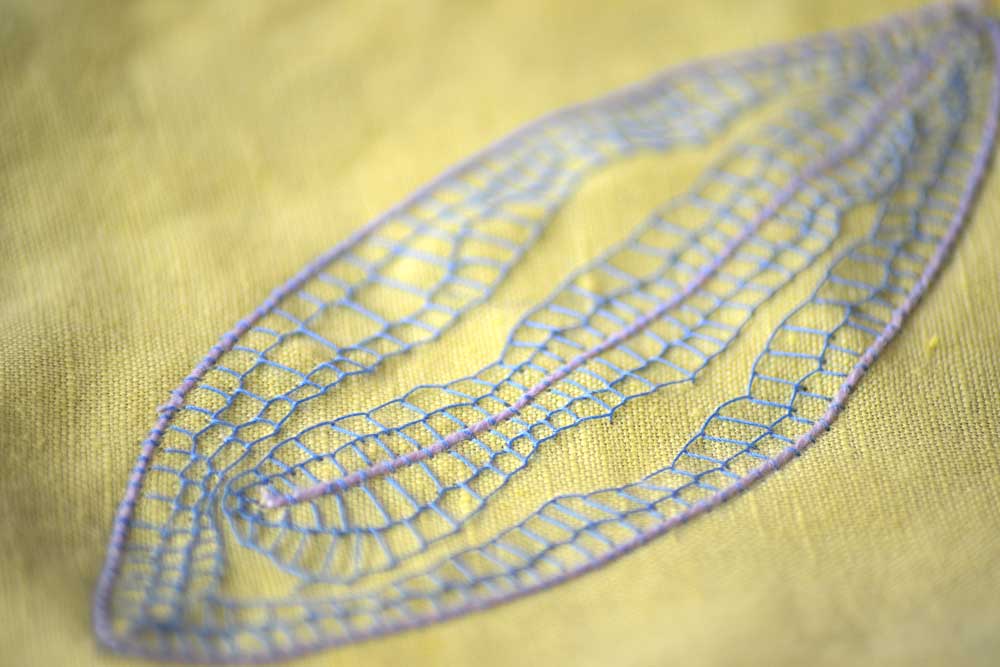
The increasing interest in slow or contemporary embroidery highlights a growing desire for hobbies that help us unwind from our fast-paced lives and alleviate daily stress.
Traditional hand embroidery has evolved in the modern world into an art form where age-old techniques merge with contemporary creativity. Unlike traditional embroidery, which primarily focuses on mending or decorating fabric with patterns, slow stitching transforms the needle and thread into a medium for artistic expression, similar to painting or sculpture.
A crucial aspect of mindfulness—despite being a frequently overused term—is its profound significance. Throughout history, individuals have participated in crafts and creative activities to calm their minds, relax, and immerse themselves fully in the present moment. Activities such as knitting, crocheting, or any other hands-on craft can effectively shift focus away from daily worries, bringing about a state of calm concentration.
In “Ikigai: The Japanese Secret to a Long and Happy Life,” authors Héctor García and Francesc Miralles explain that time seems to disappear when we engage in activities we love. They provide examples of people who start cooking and suddenly realize that hours have gone by or individuals who sit down with a book at noon and find that the entire day has slipped away. A surfer can spend countless hours in the water, wholly absorbed in the experience and often unaware of the time passing, only to feel the physical strain the next day. This deep state of immersion has been studied by Mihaly Csikszentmihalyi, an American psychologist of Hungarian descent renowned for his research on happiness, creativity, and well-being. He explored why people become so deeply engaged in an activity that they lose track of time and self-awareness, coining the term “flow” to describe this state.
According to García and Miralles, there is no single formula for happiness or universal method for discovering one’s ikigai—the reason one wakes up each day and encounters meaning in life. However, a key fulfilment component is undergoing a flow state, which Csikszentmihalyi describes as an “optimal experience.” To attain this, we should prioritize activities that naturally engage us in the flow instead of providing only instant gratification, such as overeating, substance use, or excessive screen time.
Like other mindful creative practices, slow stitching offers an opportunity to enter this immersive state, promoting relaxation and a profound sense of creative fulfilment.
The third essential aspect of slow stitching is its eco-friendly nature. This philosophy emphasizes repurposing instead of discarding, perfectly aligning with sustainability principles. Through slow stitching, old fabrics and garments are given new life, connecting us to the past while keeping us present in the current moment.
The modern Slow Stitching movement is attributed to Mark Lipinski, a prominent figure in the quilting industry. After facing health challenges, he sought to slow down and adopt a more intentional, meditative approach to embroidery. Inspired by the Slow Food movement, which opposes the culture of fast food and mass production, Slow Stitching has emerged as part of the broader slow living movement. Its essence lies in the belief that embroidery does not need to be perfect or uniform; rather, it focuses on enjoying the process instead of striving for a flawless result. Slow stitching requires no expensive tools or materials, making it an accessible and sustainable craft.
One of the most popular techniques in modern slow stitching is Sashiko, a traditional Japanese method. Initially developed for decorative and functional purposes, Sashiko was used to mend and reinforce garments. This technique emerged from practical necessity, as the white cotton thread was inexpensive, and the indigo-dyed fabric was widely available. Traditionally, Sashiko features white embroidery on a deep blue background, although festive variations sometimes include red thread. Dating back to the Edo period (1603–1867), Sashiko began as a simple running stitch used to join worn-out garments, creating more durable and substantial clothing.
During the Meiji period (1868–1912), Sashiko gained popularity, especially among northern farming communities. When winter made fieldwork impossible, people used this time to stitch, repair fabric, and experiment with decorative elements. They began incorporating fabric scraps in various colours and textures to reinforce garments and add artistic flair. This practice also found practical applications, such as creating thickly stitched, water-absorbent firefighter uniforms. Over time, what started as a utilitarian craft evolved into an art form, with intricate geometric patterns becoming a defining feature of Sashiko.
There are two primary styles of Sashiko: moyōzashi, which is characterized by long, non-intersecting lines, and hitomezashi, where the stitches meet and interlock. Common motifs include waves, mountains, bamboo, arrows, interlocking circles, and various geometric patterns.
Boro is a unique Japanese textile tradition that comes from the word “boroboro,” which means “tattered” or “repaired.” This technique involves creating patchwork fabrics, typically made from cotton, linen, or hemp, that are layered and stitched together for warmth and durability. Historically, it was more economical for villagers to grow, spin, dye, and weave their own textiles rather than buy new clothing. Because cotton was not always accessible to the lower classes, layering and mending fabric practices became common.
Indigo dye was especially popular among the working class because of its affordability and practical advantages. It could be easily cultivated in rural areas, providing a rich, long-lasting colour. It also had insect-repellent properties, which protected garments from moth damage. Unlike other dyes, the indigo solution could be reused multiple times, making it a highly cost-effective option.
During the Edo period, silk and cotton were considered luxuries prearranged for the aristocracy. For labourers, handwoven, layered textiles became essential, and Boro garments were often passed down through generations. However, as Japan entered the Meiji era and living standards improved, mass-produced textiles began to replace handmade Boroclothing. Over time, Boro came to be associated with poverty, leading to many examples being discarded or lost.
Today, Boro textiles are considered a significant aspect of Japanese aesthetics. They embody the concept of wabi-sabi, which appreciates simplicity, imperfection, and the beauty of timeworn objects. Once seen as a symbol of hardship, Borohas now been embraced as an art form that preserves the ingenuity and resourcefulness of past generations.

No Comments